Written by Jeff Foxworthy and Illustrated by Steve Bjorkman. Jeff Foxworthy is a popular and well respected comedian. He was born in Georgia and is well known for his coined phrase "you might be a red neck." In 2008 he began publishing children's books. For more information about Jeff click here. Steve Bjorkman has illustrated over 70 children's books. He lives with his wife and children in California. Visit his website.
Genre: Non-Fiction
Theme: Poetry/ Humor
Ages: 5 - 8
Summary: This is a silly story about a silly place with silly poems to describe what you see and who you would meet. There is a daily parade and all sorts of other fun things.
Link to Picture
Pre-Reading Activity: Have students think-pair-share with their elbow partner about what makes the place they live unique. Take a few examples and possibly list some adjectives on the board or a chart. Tell students that they are about to hear some poems about a very different place, and to think of some adjectives to describe the place they are hearing about.
Post-Reading Activity: Re-Read one of the poems from the text, maybe Silly Street. Have students do a free draw while listening to the words in each phrase slowly. Have them write 5 adjectives to describe what they've drawn.
Reflection: I remember hearing recordings of Jeff Foxworthy as a young girl. He is a really funny, and still a very appropriate comedian. It was surprising to me to see that he had written poetry for children's books. It is so cute and fun. Children will love all of the silly and funny details of such an interesting made up place.
Showing posts with label Rhyming. Show all posts
Friday, December 2, 2011
Thursday, November 24, 2011
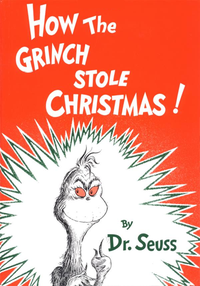
How the Grinch Stole Christmas/ ¡Cómo El Grinch robó la Navidad!
Written and Illustrated by Dr. Seuss. Theodor Seuss Geisel is his real name. He was a famous cartoonist, poet, and writer. Seuss published 46 children's books, each one beloved for its whimsical rhyme and imaginative characters. For more information about Dr. Seuss visit this site.
Link to Picture Link to Picture
Genre: Fiction
Theme: Holidays/ELL
Ages: 6-10
Summary: This is the story about how an unhappy green character, known as the grinch, plots to ruien the Christmas celebration of the Whos from Who-ville. Although their food, decorations, and presents are ransacked when the Whos awake on Christmas morning, they still share the Spirit of the holiday and sing together. The Grinch is moved by this and his heart grows 3 times as big, and he returns all of the things he had stolen.
Pre-Reading Activity: As the holiday season is approaching and classroom festivities are on the rise begin a discussion about what the holidays mean to them. Most students at a young age are excited about Santa Claus coming, receiving presents and gifts, ect. Discuss that there are deeper meanings to the holiday, giving, sharing love, family, ect.
Post-Reading Activity: Do a media comparison. After reading the book, view clips of the 1966 cartoon movie and the modern movie with Jim Carey from 2000. Discuss similarities and differences between all 3.
Reflection: To be honest, it will be highly unlikely that students will not be familiar with the story of the Grinch. However it is a good story, Dr. Seuss's use of rhyme and poetry are good examples for children to be familiar with. I also liked the idea of using a familiar text in a non English speaking language along with media to help ELL students understand the same material.
Genre: Fiction
Theme: Holidays/ELL
Ages: 6-10
Summary: This is the story about how an unhappy green character, known as the grinch, plots to ruien the Christmas celebration of the Whos from Who-ville. Although their food, decorations, and presents are ransacked when the Whos awake on Christmas morning, they still share the Spirit of the holiday and sing together. The Grinch is moved by this and his heart grows 3 times as big, and he returns all of the things he had stolen.
Pre-Reading Activity: As the holiday season is approaching and classroom festivities are on the rise begin a discussion about what the holidays mean to them. Most students at a young age are excited about Santa Claus coming, receiving presents and gifts, ect. Discuss that there are deeper meanings to the holiday, giving, sharing love, family, ect.
Post-Reading Activity: Do a media comparison. After reading the book, view clips of the 1966 cartoon movie and the modern movie with Jim Carey from 2000. Discuss similarities and differences between all 3.
Reflection: To be honest, it will be highly unlikely that students will not be familiar with the story of the Grinch. However it is a good story, Dr. Seuss's use of rhyme and poetry are good examples for children to be familiar with. I also liked the idea of using a familiar text in a non English speaking language along with media to help ELL students understand the same material.
Wednesday, November 2, 2011
Poems I Wrote When No One Was Looking
Poems written by Alan Katz with illustrations by Edward Koren. Alan Kratz is the author of the Silly Dilly series including the bestselling book, Take Me Out of the Bathtub. He has been in the entertainment industry for 30 years, as print and television writer. Includng Emmy nominated TV shows and writing parody songs for the Rosie O'Donnell Show and countless other children's cartoons. He is a self proclaimed child at heart who specializes in humorous and silly stories. For more information about Katz visit his site. Koren, a New York City resident is a famous illustrator and cartoonist, most notably for his work in The New Yorker.

Genre: Fiction
Theme: Poetry/Humorous Stories
Ages: 7-11
Summary: The book of poetry includes one hundred some poems with simple pen illustrations. Each single or open page spread contains one poem and drawing with 'side slitting' humor. The poems are whimsical. They clearly follow an influence of both Dr. Seuss and Shel Silverstein. There is a prominent use of nonsense words and language to ensure rhyme scheme, such as Seuss's work would include, and the meter and simple pen illustrations are also reminiscent of Silverstein's popular work.
Link to Picture
There are so many poems I would read one or two at a time, maybe as a transition activity as students line up for lunch or on the way back into the room settling into the next subject area.
Post-Reading Activity: Give students random pictures, collected from getting cards, magazines, and newspaper ads. Have each one come up with a small silly poem to go with their picture.
Reflection: The poems are very cute and easily relatable to children. Topics that children can relate to and understand at great depth, such as the painfulness of homework, sibling rivalry, food, and other silly things. The thing I enjoyed the most about these poems were that, even as an adult I was laughing at them. I could return to my childhood and relate back to the perspective of the children in the poems. I also particularly enjoyed the extremely witty plays on words that were utilized in many of the poems. Children would enjoy the poems for the themes and silliness alone. However, these poems could be utilized in higher grade levels, and enjoyed by adults, because of its clever puns.

Genre: Fiction
Theme: Poetry/Humorous Stories
Ages: 7-11
Summary: The book of poetry includes one hundred some poems with simple pen illustrations. Each single or open page spread contains one poem and drawing with 'side slitting' humor. The poems are whimsical. They clearly follow an influence of both Dr. Seuss and Shel Silverstein. There is a prominent use of nonsense words and language to ensure rhyme scheme, such as Seuss's work would include, and the meter and simple pen illustrations are also reminiscent of Silverstein's popular work.
Link to Picture
There are so many poems I would read one or two at a time, maybe as a transition activity as students line up for lunch or on the way back into the room settling into the next subject area.
Post-Reading Activity: Give students random pictures, collected from getting cards, magazines, and newspaper ads. Have each one come up with a small silly poem to go with their picture.
Reflection: The poems are very cute and easily relatable to children. Topics that children can relate to and understand at great depth, such as the painfulness of homework, sibling rivalry, food, and other silly things. The thing I enjoyed the most about these poems were that, even as an adult I was laughing at them. I could return to my childhood and relate back to the perspective of the children in the poems. I also particularly enjoyed the extremely witty plays on words that were utilized in many of the poems. Children would enjoy the poems for the themes and silliness alone. However, these poems could be utilized in higher grade levels, and enjoyed by adults, because of its clever puns.
Subscribe to:
Posts (Atom)