Saturday, December 3, 2011

A is for Abigail- An Almanac of Amazing American Women

Written by Lynne Cheney and Illustrated by Robin Preiss Glasser. Mrs. Cheney, the former 2nd wife the the United States of America.  (Former Vice President Dick Cheney's wife) Glasser was first a successful ballet artist.  Now she is a well known children's literature illustrator.  To find out more click here.

Genre: Non-Fiction/Biography
Theme: Historical Women/ Alphabet
Ages: 7-11

Summary: This is an alphabet book that for each letter highlights an important woman or concept for american history.


Link to Picture

Pre-Reading Activity: Ask students to name important historical figures. You may or may not be surprised, but most names that pop up will be male.  Have a discussion about how men and women are equally important to our history and bringing us to where we are today.

Post-Reading Activity: Using this text as a center activity have individuals or small groups review the page that was read aloud in class for the day.  Have them keep a log, or fill out a worksheet keeping track of the letter for the day, important names, what they did, and at least 2 other facts from the page.

Reflection: To be honest this is a book so full of wonderful facts and historical information that I may take only one person/page at a time, maybe each day or highlight one woman a week.

Always and Forever

Written by Alan Durant and Illustrated by Debi Gliori. Durant is a United Kingdom native, born in Surry.  He loved to read as a child, especially C.S. Lewis's Narnia Series. He lives with his wife and family and makes them be his 'guinea pigs' and listen to his stories for him. For more information click here.  Debi Gliori is a Scottish children's book author and illustrator. She grew up as an only child and has been creating children's books since the late 70s.  She has 5 children and a golden retriever, for more information click here.

Genre: Fiction
Theme: Animals/Social Issues/Death & Grief
Ages: 4-9

Summary:  When their friend Fox falls ill and dies, his housemates, Otter, Mole, and Hare are saddened.  They feel as though they can not go on. One day Squirrel comes to visit and reminds them of Fox's wisdom and all of the funny things he used to do. This makes them laugh for the first time in a long while.  They come up with ideas and ways for how to honor Fox, but continue living because they realize that Fox's love and memory will always be with them.

Link to Picture

Pre-Reading Activity: Think of a time when you have lost someone close to you.  It does not have to be a death, maybe someone moved away, or you had to move.  Remember the way you felt when they had to go. Some of you may not know what this feeling is like yet, but you can imagine.

Post-Reading Activity:  Now, think of the person we had in mind before reading the book.  Try to remember a happy memory of that person.  Write at least one good sentence describing what you liked about that person, and what makes them special.

Reflection: To be honest, I would not address this book with a full class unless a peer or a well known person was lost.  It is a very sensitive subject matter, however is such a wonderful book for anyone dealing with the loss of a loved one.  It would be a great text for helping someone to cope through a difficult time.

Henry & the Buccaneer Bunnies

Written by Carolyn Crimi and Illustrated by John Manders. Carolyn was born and raised in Long Island, New York.  She lives with her husband and pug in New York currently. For more information click here. John Manders studied at the Art Institute of Pittsburgh. He is interested in puppetry and learning to speak Italian. To find out more click here.

Genre: Fiction
Theme: Animals/ Adventure/Pirates
Ages: 5-9

Summary: The story begins on a ship called the Salty Carrot sailing the seas.
The ship is captained by a big, bad, mean named Barnacle Black Ear, who is embarrassed by his son Henry who is more interested in reading books then being a pirate. However, his love of books and his library are able to save the day.


Link to Picture

Pre-Reading Activity:  Have students look at the cover and title of the book.  Ask them to share their observations, inferences, and predictions.  Invite students to recall a time when they had learned something useful from school or from reading.  Ask them how it made them feel to know something new and interesting.

Post-Reading Activity:  Have students do a free write about how it would feel to be in Henry's shoes.  They can choose to write about their thoughts and questions for Black Ear.  They can retell the story from a 1st person perspective. Or they may write about a time something similar happened to them.

Reflection: This is a great book about the love of reading.  It is so great that the main character is able to not only save the day but continue to improve their lives because of the knowledge gained from reading.  Such a cute book.

The Lion & The Mouse

By Jerry Pinkney.  A native of Philadelphia he studied at the Philadelphia College of Art.  He is an award winning illustrator of children's books, having been honored 5 times each by the Caldecott Honor and the Coretta Scott King Award.  He currently lives in Westchester County, NY with his wife.  For more information click here.

Genre: Fiction
Theme:Animals/ Folklore/Fables
Ages: 3-8

Summary:  This is a wordless picture book version of the Aesop fable about the lion and the mouse.  The unlikely pair of creatures learn to help one another and build a friendship.


Link to Picture

Pre-Reading Activity:   Assess prior knowledge by asking if anyone had ever heard of a fable, or knew what one was.  Have a brief discussion about folklore or wise advice in the form of stories.  Ask students if they have ever heard a story about the lion and the mouse. Read a short version of Aesop's Fable, "The Lion and the Mouse".  Have students keep this brief story in mind as they go through this wordless picture book.

Post-Reading Activity: Have students individually, in pairs, or in small groups depending on class size and ability take one page each of the story, and write the words to describe what is happening in it.  Compile class  written words to go along with pictures and create the book.  Read to whole class to see how well everyone has done with creating their own story to go along with the pictures.

Reflection: I really enjoy nearly text less picture books.  They create a world of imagination and individuality to the reader responsible for creating meaning for the pictures. This is a great opportunity to discuss making inferences and observations to support them.  It is also a wonderful text to discuss sequencing, the events of the story are still known thanks to the order of the pictures.

Friday, December 2, 2011

Silly Street

Written by Jeff Foxworthy and Illustrated by Steve Bjorkman. Jeff Foxworthy is a popular and well respected comedian.  He was born in Georgia and is well known for his coined phrase "you might be a red neck."  In 2008 he began publishing children's books.  For more information about Jeff click here. Steve Bjorkman has illustrated over 70 children's books.  He lives with his wife and children in California. Visit his website.

Genre: Non-Fiction
Theme: Poetry/ Humor
Ages: 5 - 8

Summary: This is a silly story about a silly place with silly poems to describe what you see and who you would meet. There is a daily parade and all sorts of other fun things.


Link to Picture

Pre-Reading Activity: Have students think-pair-share with their elbow partner about what makes the place they live unique.  Take a few examples and possibly list some adjectives on the board or a chart.  Tell students that they are about to hear some poems about  a very different place, and to think of some adjectives to describe the place they are hearing about.

Post-Reading Activity:  Re-Read one of the poems from the text, maybe Silly Street.  Have students do a free draw while listening to the words in each phrase slowly.  Have them write 5 adjectives to describe what they've drawn.

Reflection: I remember hearing recordings of Jeff Foxworthy as a young girl.  He is a really funny, and still a very appropriate comedian.  It was surprising to me to see that he had written poetry for children's books.  It is so cute and fun.  Children will love all of the silly and funny details of such an interesting made up place.

Thursday, December 1, 2011

Old Bear

Written and Illustrated by Kevin Henkes. Henkes is a popular children's book author and illustrator awarded with the Caldecott Medal and Newbery Honor for his works.  Growing up he thought he would become an artist when a teacher encouraged him in his writing.  He has since had a successful career in children's literature.


Genre: Fiction
Theme: Animals/Seasons
Ages: 3 - 6

Summary: This story is about a bear that goes into hibernation for the winter.  While he sleeps he dreams of each of the four seasons and what makes them beautiful.  When he awakes, he doesn't realize how much time has passed and that it has stopped snowing and it is lovely spring already.


Link to Picture

Pre-Reading Activity:Talk to students about the changes in weather as winter is approaching.  Ask what they have noticed is different in the weather, or if they have seen any changes with the animals.  See if students understand the concept of hibernation offer some background knowledge if necessary.

Post-Reading Activity: Have students do a writing activity about what their favorite season of the year is and why.  They will have to give one description of what the season is like, and why they enjoy it. Or have students complete a science activity sheet on what are the four seasons and what order do they cycle in.

Reflection: This is a sweet story that talks about the seasons and a bears hibernation.  It is great to do a science content area literature text.

Wednesday, November 30, 2011

If You Give a Cat a Cupcake

Written by Laura Numeroff and Illustrated by Felicia Bond.  Numeroff born in Brooklyn New York and is the author of the popular "If You Give a Mouse a Cookie"  books.  She was honored by Laura Bush at the White House for the "Laura Bush Honors American Authors" event. Bond, the illustrator for the popular series, currently lives with her family in Santa Fe, Texas.  For more information about them both, and the book series click here!

Genre: Fiction
Theme: Animals/Food
Ages: 3-6 years

Summary:  If you give a cat a cupcake, he'll ask for sprinkles to go with it.  Which spirals into a whole story of "If....then..." scenarios which are so silly and fun the reader will be delighted. The story finally loops back to the sprinkles and cupcake to bring the ending full circle.   


Link to Picture

Pre-Reading Activity:   Introduce the story a mini lesson on cause and effect. The "if...then..." scenarios of the story are a great way to solidify the concept.  Ask students if they have ever been told by their parent that "If you finish your vegetables, then you can have dessert".  Explain the cause and effect works with weather, if it rains then you have to use an umbrella.  As class if they can think of examples of cause and effect.  Tell students that this story will have many causes and effects and to be listening closely for them.

Post-Reading Activity:  Have students write about an "if...then..." scenario in their life.  This can be a free write activity in a journal, or a worksheet created by instructor.  Students may model cat and cupcake examples from the text, or create ones of their own.

Reflection:  When I was a child I loved reading through the mouse and moose books in this series.  This story is full of animals, foods, sequences, and a fun series of events that will keep children excited and laughing along.

Monday, November 28, 2011

I Wanna Iguana

Written by Karen Kaufman Orloff and Illustrated by David Catrow.  Karen wanted to be a writer from the time she was a small child.  She now loves to write for children, especially her own children.  Check out her website.  David Catrow also loved his craft throughout his childhood, birthed in Virginia but raised in Michigan. He now lives in Ohio with his wife and dogs. Learn more here.

Genre: Fiction
Theme: Animals
Ages: 4 - 8

Summary: This is a story about a young boy who wants a pet iguana.  He writes letters trying to persuade his mother to allow him to have an iguana.  His mother replies to his letters with clever counter arguments and thoughtful questions. Once they set some parameters for a trial period the mother's final letter tells the boy to look on his dresser, where his new pet iguana is waiting for him.

Link to Picture

Pre-Reading Activity: Assess prior knowledge about what students know about iguanas.  Create a KWL chart if preferable.  Tell class to listen closely for information and new things they can learn about this animal.

Post Reading Activity: Have class as a whole, or individually compose a persuasive letter for why they do or do not "wanna iguana".  Talk as a class about what good letters need to have and also how to prove a point or make a good argument by providing facts and evidence to support one's thoughts.

Reflection:  This is a cute story. This young boy is nearly desperate for something, but has to work hard and convince his parents of how important it is to him.  It is a great way to learn more about iguanas, letter writing, problem solving, and responsibly.  I personally love how each time the son signs the letter he describes himself in a new humorous way.

Dear Deer - A Book of Homophones

Written and Illustrated by Gene Barretta. Barretta is an award winning author and illustrator of children's books.  He currently lives outside of Philadelphia, PA with his wife and family.  His little brother is actually a performer for the Muppets. Check out Gene's Website


Genre: Fiction/English Language
Theme: Animals/Homophones
Ages: 4 - 7

Summary: Aunt Ant has a new home at the zoo.  She writes a letter to Deer, describing, completely in homophones,


Link to Picture

Pre-Reading Activity: Mini Homophone lesson.  Introduce the character at begining of text.  Aunt Ant.  Write these two words on the board and explain that they are homophones, which are two words which sound alike but a spelled differently and have different meanings.  Ask students to explain what each word means. (A relative versus an insect.) Lead into story by telling class that they will read story that begins with a letter about Aunt Ants new home, the zoo.

Post-Reading Activity: Have class offer homophones that they recall from the book.  Make Homophone chart   and have students describe how the words are different.

Reflection:
This is a wonderful story to help teach about homophones in an English lesson.  Children will love the funny stories about animals at the zoo doing silly things.  It may be great lesson to teach within a Animal unit or after a trip to the zoo.

Sunday, November 27, 2011

Good Night Gorilla

By Peggy Rathmann. Born and raised in Minnesota she received her degree in Psychology at the University of Minnesota.  She now lives with her husband and family on a ranch in California.  To visit Peggy's official site and for more information click here.

Genre:  Fiction
Theme: Animals/Zoo
Ages: 2 - 6

Summary: A zoo keeper says goodnight to the animals on his way through heading home.  A playful gorilla gets a hold of his keys and the animals follow him home and surprise his wife.


Link to Picture

Pre-Reading Activity: Ask students if they have a schedule of events, order, or routine at night before bed time.  Tell students what your night time routine is and ask some students to share one thing that they always do before bed time.  Be sure to include who you say good night in your explanation, as the upcoming text is about saying goodnight.

Post-Reading Activity: Have students make a list of the people and things they want to say goodnight to. Have them complete the "Good night, ..." pattern for at least 3 things/people of their choosing.

Reflection: This is nearly wordless picture book the illustrations tell such a great story.  It is a great story to talk about animals as well.

Saturday, November 26, 2011

I'm the Biggest Thing in the Ocean

By Kevin Sherry.  There is not much publicly posted about Kevin Sherry, he is a working artist.  He teams with Jean-Baptiste Regnard to create an artistic t-shirt line that was first released in 2005.  To check out more of his art work click here


Genre: Fiction
Theme: Animals/Concepts of Size
Ages: 4-8

Summary: This is a story about a Squid who is comparing himself to other things and creators around him in the sea.  He declares that he is the biggest thing of them all until he gets swallowed up by a much larger whale.

Pre-Reading Activity:  Have students name some things they might see in the Ocean.  Have partners discuss the different animals or fish that live in the ocean.  Have them keep track to see if the things they thought of will be mentioned in the book.

Post-Reading Activity: Have students compare objects and numbers for size or quantity.  Tie into math lesson about greater than, less than, or equal to. 

Reflection:  This is such a cute little story.  The squid is often in too large a view to fit on the page of the book.  There are bright vivid colors and the text is large and exciting.  It will make children laugh when they find out that the squid had an inflated ego all along.

Friday, November 25, 2011

John Paul George & Ben

Written and Illustrated by Lane Smith. Smith has a popular publishing reputation putting interesting spins to well known stories. He grew up in California but returned to his birth place of Oklahoma every summer of his childhood. He is now a famous illustrator and lives in New York City. To find out more click here.

Genre: Fiction
Theme: History/American Revolution
Ages: 6 - 10

Summary:  This book has many sections, each beginning with an characteristic trait or adjective to describe the founding fathers and other historical men from the American Revolution him period. There is some truth in each story, but mainly funny and silly stories about these figures during their childhoods.


Link to Picture

Pre-Reading Activity:  This text is a good way to kick off a history unit on the American Revolution. Start a discussion with the students about important people they know with the first name John, Paul, George, and or Ben.  As students guess correctly they will notice a trend in the names being presidents of from Colonial times.

Post-Reading Activity: At the end of the text there is a page with true or false facts.  Taking liberties with the facts is something that happens in the text.  Using this page to have the class vote for true or false for each statement.   Have a conversation about that even though it is fun to take liberties to make silly stories we need to stress the importance of truth and facts for accuracy.

Reflection:  What is so nice about this book is that it makes history less serious and heavily fact laden.  It makes history funny, it would be great to compare with actual facts.  At the nearly the end of the book there are descriptions with more historical fact to explain why the adjective previously used to describe them is a good choice.

Thursday, November 24, 2011

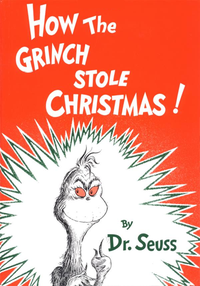
How the Grinch Stole Christmas/ ¡Cómo El Grinch robó la Navidad!

Written and Illustrated by Dr. Seuss. Theodor Seuss Geisel is his real name.  He was a famous cartoonist, poet, and writer.  Seuss published 46 children's books, each one beloved for its whimsical rhyme and imaginative characters.  For more information about Dr. Seuss visit this site.


Link to Picture                   Link to Picture


Genre: Fiction
Theme: Holidays/ELL
Ages: 6-10

Summary: This is the story about how an unhappy green character, known as the grinch, plots to ruien the Christmas celebration of the Whos from Who-ville. Although their food, decorations, and presents are ransacked when the Whos awake on Christmas morning, they still share the Spirit of the holiday and sing together.  The Grinch is moved by this and his heart grows 3 times as big, and he returns all of the things he had stolen.

Pre-Reading Activity:  As the holiday season is approaching and classroom festivities are on the rise begin a discussion about what the holidays mean to them.  Most students at a young age are excited about Santa Claus coming, receiving presents and gifts, ect. Discuss that there are deeper meanings to the holiday, giving, sharing love, family, ect.

Post-Reading Activity: Do a media comparison.  After reading the book, view clips of the 1966 cartoon movie and the modern movie with Jim Carey from 2000.  Discuss similarities and differences between all 3.

Reflection: To be honest, it will be highly unlikely that students will not be familiar with the story of the Grinch. However it is a good story, Dr. Seuss's use of rhyme and poetry are good examples for children to be familiar with. I also liked the idea of using a familiar text in a non English speaking language along with media to help ELL students understand the same material.  

Wednesday, November 23, 2011

A Swim through the Sea

Written and Illustrated by Kristin Joy Pratt. This author illustrator began her career during high school.  She is now married and becoming a popular artist and writer.  To find out more about Pratt click here.

Genre: Non-Fiction
Theme: Animals/Marine Life/ Habitat, Alphabet
Ages: 4 - 7

Summary: This is an alphabet story about Seamore the seahorse and the many different animals he'd see if he went exploring the sea.  From A to Z  he sees clown fish, dolphins, and many more creatures.


Link to Picture

Pre-Reading Activity: Ask students if they recall how they had to learn names of their classmates.  Remind them about how the name game works.  Have a go around practicing the rules. Example: "My name is Mrs. Roeder, and I like to read."  This is a great way to practice alliteration skills. Students will see alliteration used in the following text.

Post-Reading Activity:  Students should discuss the habitat they have learned about in this book, marine life.  Discuss other habitats then have students write about the other 'animals' (family members and pets) that coexist with them in their habitat.

Reflection: This is a great source for animals, fish, habitat, alphabet, and even alliteration skills. The pictures are vibrant and accurate. It is a wonderful text for science and literature cross curricular content.

Wednesday, November 16, 2011

10 Little Rubber Ducks

Written and Illustrated by Eric Carle. Carle is most famous for creating the children's classic "The Very Hungry Caterpillar" which was published in 1969.  He is a Syracuse, New York native, but grew up was educated in Germany.  He returned to New York and has been an author illustrator ever since.  To find out more about Eric Carle check out his website.

Genre: Non-Fiction
Theme: Animals, Numbers/Counting
Ages: 2-7

Summary:  The story begins with rubber duckies being manufactured in a factory and then their travels by distribution. When one box of 10 rubber ducks fall overboard.   As they drift apart at sea each passes different animals on their way.


Link to Picture

Pre-Reading Activity: Tell students that they will be hearing a story about rubber ducks.  Have them explain the differences between living ducks and rubber ducks. Make a chart with differences.

Post Reading Activity: Have students take on the role of the 11th rubber duck.  Have them do a journal response about what direction they would drift in the water, what animal they would see, and what that animal would do.

Reflection:  What I like initially when reading this story is that on the very first page is that there are 10 out lines of rubber duckies for children to practice counting up to 10.  I also enjoy that there are lots of onomatopoeias and words that help create sound into the reading.  Eric Carle creates an enviornment that makes the reader feel completely emerged. He also uses a literary technique of repetition which is a good tool for young writers.  If you own the hardcover edition of this text it ends with a literal squeak!

10 Little Penguins

"A Pop-Up Book from the bestselling creators of 365 Penguins."
Written by Jean-Luc Fromental and illustrated by Joelle Jolivet.
Fromental is a French screenwriter, author, and publisher.  Beginning her illustration career in the late 80s, she began to team with Fromental in the mid 2000's.  Together the team has produced several popular and famous children's books about penguins and more.


Genre: Fiction
Theme: Animals/Numbers
Ages: 4 - 7

Summary:  This pop up book is also interactive with arrows to pull and penguins to count.  Starting at 10 and working the way down to 0, the penguins are all having mischievousness fun until one by one they all leave in unique ways.  


Pre-Reading Activity:  Ask for 10 students to line up in front of classmates one by one, have remaining students count out loud how many they have. Repeat the process asking students to leave the line to join their peers.  Have class count down from 10 to 0.  Instruct the class that the skill of counting downward from 10 will be very helpful in reading this story.

Post-Reading Activity: Have students make their own 10 little (insert animal here) book following the pattern.  The initial assignment would be to create their own title and cover page for the book.  For adaptation or to create full length book students may begin at the number 5 and work their way down. 

Reflection:  This book is the kind that the reader wants to get up very closely to and play with.  Students will want to count each penguin with their fingers.  I really enjoy that this book can be used to talk about art, math, animals, habitat  and even the importance of how to care for books. 

Tuesday, November 15, 2011

That's Like Me!

Written by Jill Lauren. Lauren received both her B.A. and M.A. in Learning Disabilities from Northwestern University.  She has been teaching students with Learning Disabilities in the classroom for 25 years.  Her expertise has led to her ability to be an on-call consultant today in New York City, where she will also give the occasional lecture.

Genre: Nonfiction
Theme: Learning Disabilites
Ages: 8 and up

Summary: Includes the first hand account of 15 children and adults that learn differently. Each is uniquely successful in their endeavors, yet faced with challenges in school.


Link to Picture


Pre-reading Activity:

Post-Reading Activity:

Reflection:

Susan Laughs

Written by Jeanne Willis and illustrated by Tony Ross.  Willis was born in the UK, in St Albans, Herts.  She was very close with her grandparents growing up, she wrote her first novel on her grandmother's manual typewriter.  She was married at the London Zoo and lives with her family today.  While Ross is best known for his illustration, he also has written several of his own books, including the Little Princesses series.


Genre: Fiction
Themes: Disability
Ages: 6 and Up

Summary: This is another sweet children's picture book which begins with a simple repeating structure of 'Susan rows, Susan throws, ect...” Susan can do anything a typical child can do. This is a surprising story because you do not know that the protagonist is anything but typical until the very last page. You discover that Susan is physically handicapped and needs to use a wheel chair but you only know that from the picture, the story ends with the words that she is just like me and you. This text sparks great discussion for not underestimating the abilities of those with special needs.

Link to Picture

Pre-Reading Activity:

Post-Reading Activity:

Reflection:

My Friend Has Down Syndrome

Written by Amanda Doering Tourville and illustrated by Kristin Sorra.  Tourville lives in Eagan, Minnesota with her husband and her pet bulldog.  Sorra is an avid painter, having illustrated two other books as well. Today, she lives in New York with her husband (who is also an artist) and pet dog.

Genre: Nonfiction
Themes: Friendship/Relationships
Ages: 5 and up

Summary: This is another book from the "Friends with Disabilities" Series. See entry on "My Friend has Autism" for more detail.


Link to Picture

Pre-Reading Activity:

Post-Reading Activity:

Reflection:

My Friend Has Autism

Written by Amanda Doering Tourville and illustrated by Kristin Sorra. Tourville lives in Eagan, Minnesota with her husband and her pet bulldog. Sorra is an avid painter, having illustrated two other books as well. Today, she lives in New York with her husband (who is also an artist) and pet dog.
Genre: Nonfiction
Themes: Friendships/Relationships
Ages: 6 and up

Summary:  This is a cute children's story helping to describe what people with autism may be like. It is the short story of a young boy who is friends with another young boy from an airplane club. Each page includes a little 'did you know?' note that helps to explain common characteristics of people with autism. It is a great beginning book for introducing this condition to children. This text also offers other books and even web sites to consider for looking for more information.

Link to Picture

Pre-Reading Activity:

Post-Reading Activity:

Reflection: